


Cardinal Antony Padiyara and Maria Valtorta

Born on February 11, 1921 and died on March 23, 2000, Cardinal Antony Padiyara was a Major Archbishop of the Syro-Malabar Church of Kerala (India) and a Council Father. The Church of Kerala is a place of ancient evangelization: it traces back to the apostle Thomas.
The Syro-Malabar Church[edit | edit source]
It is one of the 23 Eastern Catholic Churches, in full communion with Rome, but with its own liturgy and organization, rooted in its history. This is the case of the Coptic Church (Alexandrian tradition), the Maronite Church (Syriac tradition), the Armenian Church, the Ukrainian Church (Byzantine tradition), and the Syro-Malabar Church (Chaldean tradition). In this Church, prelates and saints bear the name "Mar," an Aramaic word meaning "Lord," found in the expression "Maranatha" (Lord, come!) which concludes the Book of Revelation.
These Eastern Catholic Churches are led by a Patriarch. The Syro-Malabar Church is led by a Major Archbishop who holds the equivalent authority without the title. This is the role of Cardinal Antony Padiyara, who expressed his views on the work of Maria Valtorta.
Origin and Development[edit | edit source]
Tradition holds that the apostle Thomas arrived on the Malabar coast around the year 52 and founded several Christian communities. Even if the historical details are difficult to verify, it is certain that an organized Christian community existed in this region from the earliest centuries, linked to trade between the Near East and India.
These Christians were in contact with the Syriac-speaking Churches of Mesopotamia, notably the Church of the East, from which they received their liturgy, their sacred language (Syriac), and part of their theology and ecclesiastical organization.
The shock of the arrival of the Portuguese (Vasco da Gama), who sought to Latinize these Churches, provoked a split between the Syro-Malabar Church, which joined Rome, and another branch that would join it later: the Syro-Malankara Catholic Church. The see of the former is in Ernakulam (Kerala); it is the majority Church. The see of the latter is in Thiruvananthapuram (or Trivandrum), the capital of Kerala. Catholics represent 11 to 12% of the population of Kerala, which numbers 33 million inhabitants, not counting the faithful of the Diaspora.
Opinion on the Work of Maria Valtorta[edit | edit source]
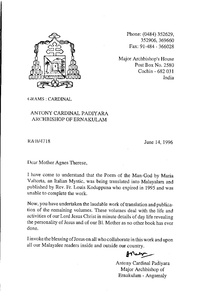
In 1992, Father Louis Koduppuna translated the work of Maria Valtorta into Malayalam, a language spoken in southern India and particularly in Kerala. This initiative was welcomed by various bishops.
In 1996, following the death of Father Louis Koduppuna the previous year, the Cardinal highlighted the remarkable nature of the work:June 14, 1996Dear Mother Agnes Therese,
I have come to understand that the Poem of the Man-God[1] by Maria Valtorta, an Italian Mystic, was being translated into Malayalam and published by Rev. Fr. Louis Koduppuna who expired in 1995 and was unable to complete the work.
Now, you have undertaken the laudable work of translation and publication of the remaining volumes. These volumes deal with the life and activities of our Lord Jesus Christ in minute details of day life revealing the personality of Jesus and of our Blessed Mother as no other book has ever done.
I invoke the blessing of Jesus on all who collaborate in this work and upon all our Malayalee readers inside and outside our country.
Antony Cardinal Padiyara
Major Archbishop of
Ernakulam - Angamaly
This translation met with considerable success, judging by the written opinions that have reached us from various regions of India. This reception is characteristic of the Asian continent, as evidenced by the reaction of the Chinese bishops,[2] who suggested, for the purposes of evangelization, that the work of Maria Valtorta be translated into their language (2008).
Opinions of Other Indian Bishops[edit | edit source]
| Mar (Msgr.) Benoît Gregorios and Maria Valtorta, | Msgr. Eric Benjamin Moktan and Maria Valtorta | Msgr. Valerian D'Souza and Maria Valtorta |
|---|---|---|
|
Primate of the Syro-Malankara Catholic Church and Council Father, he welcomed the fact that this translation of Maria Valtorta's work would contribute "to making Jesus Christ better known and loved." |
First indigenous bishop of Darjeeling, West Bengal, he wrote that "the initiative is important, but it is worth it, given the intrinsic value and popularity of these books." |
Bishop of Pune (Poona), Maharashtra, he shared that Maria Valtorta's work had brought him a great deal in his personal life and ministry. The work should be widely distributed and read, as he himself took the initiative to do. |


| Msgr. Maria Callist Soosa Pakiam and Maria Valtorta | Mar Joseph Kundukulam and Maria Valtorta | Msgr. Joseph Kureethara and Maria Valtorta |
|---|---|---|
|
Archbishop of Trivandrum, Kerala, and President of the Catholic Bishops' Conference of Kerala, he stated that it is "an invaluable contribution to the mission of the Church to make Our Lord and Savior, Jesus Christ, known and loved." |
Archbishop of Trichur, Kerala, he clearly took a position in favor of the work: "Pope Pius XII, after reading them, expressed his trust in these visions. Even if the Church has not officially declared them authentic, readers can read them with great spiritual benefit, and understand in detail what the Evangelists wrote succinctly." |
File:Bp Kureethara.png Mgr Joseph Kureethara Bishop of Cochin, Kerala, he affirmed his conviction that Maria Valtorta truly saw and heard what she recounts. He declared that nothing in these writings is contrary to faith or morals. |


Notes and References[edit | edit source]
- ↑ Known today under the title The Gospel as Revealed to Me.
- ↑ On April 27, 2007, the Chinese bishops, in preparation for a synod on The Word of God in the Life and Mission of the Church, expressed the wish that the works of Maria Valtorta continue to be translated into their language "to help the people of God to appreciate the evangelical message" (See note n°9).