


Mgr Roman Danylak, preface of "Gospel as revealed to me" (2001)
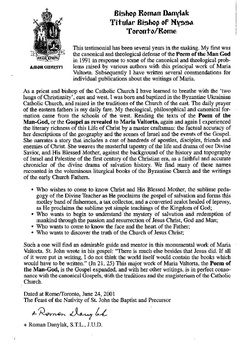
When Bishop Roman Danylak wrote this preface for the second English edition, he was 81 years old. Retired in Rome, a city he frequented extensively during his 13 years as a consultor for the revision of the canon law of the Eastern Churches, to which he belonged. He signs as titular bishop of Nyssa, a diocese now defunct. This means that he is now a titular bishop, without a diocese to govern, occupying an ancient and symbolic episcopal see (in partibus). This expression "in partibus" refers to the distant geographical situation of this see. Such titles are also held by bishops appointed to administrative functions within the Roman Curia or by auxiliary bishops.
Bishop Roman Danylak presents this text as a synthesis of the recommendations, the Nihil obstat and imprimaturs granted.
Preface - Original English Text[edit | edit source]
Bishop Roman Danylak, Titular Bishop of Nyssa, Toronto/Rome
This testimonial has been several years in the making. My first was the canonical and theological defense of the Poem of the Man God in 1991 in response to some of the canonical and theological problems raised by various authors with this principal work of Maria Valtorta. Subsequently I have written several commendations for individual publications about the writings of Maria.
As a priest and bishop of the Catholic Church I have learned to breathe with the ‘two lungs of Christianity’, east and west. I was born and baptized in the Byzantine Ukrainian Catholic Church, and raised in the traditions of the Church of the east. The daily prayer of the eastern fathers is my daily fare. My theological, philosophical and canonical formation came from the schools of the west. Reading the texts of the Poem of the Man-God, or the Gospel as revealed to Maria Valtorta, again and again I experienced the literary richness of this Life of Christ by a master craftsman: the factual accuracy of her descriptions of the geography and the scenes of Israel and the events of the Gospel. She narrates a story that includes a cast of hundreds of apostles, Disciples, friends and enemies of Christ. She weaves the masterful tapestry of the life and drama of our Divine Savior, and His Blessed Mother, against the background of the history and topography of Israel and Palestine of the first century of the Christian era, as a faithful and accurate chronicler of the divine drama of salvation history. We find many of these names recounted in the voluminous liturgical books of the Byzantine Church and the writings of the early Church Fathers.
- Who wishes to come to know Christ and His Blessed Mother, the sublime pedagogy of the Divine Teacher as He proclaims the gospel of salvation and forms this motley band of fishermen, a tax collector, and a converted zealot healed of leprosy, as He proclaims the sublime yet simple teachings of the Kingdom of God;
- Who wants to begin to understand the mystery of salvation and redemption of mankind through the passion and resurrection of Jesus Christ, God and Man;
- Who wants to come to know the face and the heart of the Father;
- Who wants to discover the truth of the Church of Jesus Christ;
Such a one will find an admirable guide and mentor in this monumental work of Maria Valtorta. St. John wrote in his gospel: "There is much else besides that Jesus did. If all of it were put in writing, I do not think the world itself would contain the books which would have to be written." (Jn 21:25) This major work of Maria Valtorta, the Poem of the Man-God, is the Gospel expanded, and with her other writings, is in perfect consonance with the canonical Gospels, with the traditions and the magisterium of the Catholic Church.
Dated at Rome/Toronto, June 24, 2001
The Feast of the Nativity of St. John the Baptist and Forerunner
+ Roman Danylak, S.T.L., J.U.D.
French Translation[edit | edit source]
(ChatGPT translation - unofficial)
This testimonial has taken several years to come to fruition. My first was the canonical and theological defense of the Poem of the Man-God in 1991, in response to some of the canonical and theological problems raised by various authors regarding this principal work of Maria Valtorta. Subsequently, I have written several recommendations for individual publications on Maria’s writings.
As a priest and bishop of the Catholic Church, I have learned to breathe with the "two lungs of Christianity," east and west. I was born and baptized in the Byzantine Ukrainian Catholic Church, and raised in the traditions of the Church of the East. The daily prayer of the eastern fathers is my daily nourishment. My theological, philosophical, and canonical formation comes from the schools of the West. Reading the texts of the Poem of the Man-God, or the Gospel revealed to Maria Valtorta, again and again, I experienced the literary richness of this Life of Christ by a true master of the pen: the factual precision of her descriptions of the geography, the scenes of Israel, and the events of the Gospel. She tells a story that includes a multitude of Apostles, Disciples, friends, and enemies of Christ. She weaves a masterful tapestry of the life and drama of our Divine Savior and His Holy Mother, set against the history and topography of Israel and Palestine of the first century of the Christian era, as a faithful and accurate chronicler of the divine drama of salvation history. We find many of these names mentioned in the voluminous liturgical books of the Byzantine Church and in the writings of the early Church Fathers.
- One who wishes to know Christ and His Holy Mother, the sublime pedagogy of the Divine Master as He proclaims the Gospel of salvation and forms this motley band of fishermen, a tax collector, and a converted zealot healed of leprosy, as He proclaims the sublime yet simple teachings of the Kingdom of God;
- One who wants to begin to understand the mystery of the salvation and redemption of humanity through the passion and resurrection of Jesus Christ, God and Man;
- One who wishes to know the Face and the Heart of the Father;
- One who wants to discover the truth of the Church of Jesus Christ;
Such a person will find an admirable guide and mentor in this monumental work of Maria Valtorta. Saint John wrote in his Gospel: "There is much more besides that Jesus did; if they were all written down, I do not think the world itself would contain the books that would be written." (Jn 21:25) This major work of Maria Valtorta, The Poem of the Man-God, is the expanded Gospel, and with her other writings, it is in perfect harmony with the canonical Gospels, with the traditions, and the magisterium of the Catholic Church.
Dated at Rome/Toronto, June 24, 2001
Feast of the Nativity of Saint John the Baptist and Forerunner
Roman Danylak, S.T.L.[1], J.U.D.[2]
Notes and References[edit | edit source]
Note: Quotations from the work of Maria Valtorta on this page currently use machine-translated text and will gradually be replaced by the official English translation. Until then, the official translation may be consulted through the reference link provided with each quotation.
- ↑ S.T.L. stands for Sacrae Theologiae Licentiatus (Licentiate in Sacred Theology). It is an advanced degree in theology, often required for academic or ecclesiastical positions within the Catholic Church.
- ↑ J.U.D. stands for Juris Utriusque Doctor (Doctor of both Laws – canon and civil). This title indicates that the person obtained a doctorate in canon law, which governs the organization and functioning of the Catholic Church, and sometimes in civil law as well. These titles indicate that Bishop Roman Danylak had in-depth academic training in theology and canon law.