


Caesarea on the Sea
 Not to be confused with Caesarea Philippi/Paneas.
Large maritime port and Roman garrison.

Inhabitants or Natives[edit | edit source]
Ennius, Florus and Marcus, the debauched Romans, Aurea Galla (Christina), Isaac and Lucius Caius, two young children, Valeria's husband, Simon the ropemaker, Syntyche, Valerian his cruel master, a Confessiongle healed by Jesus.
Description[edit | edit source]

“You can see the port and the ships. Here, there are many warehouses and shops”[1]...“The city appears stretched out on the shore, beautiful as any place where the refined civilization of the Romans is displayed. Baths and marble palaces show their whiteness like blocks of frozen snow in the neighborhoods closest to the sea, guarded by a white tower as well, square-shaped, built near the port. Perhaps a Camp or an observatory. Then the more modest houses of the outskirts, of Hebrew style, and everywhere the greenery of trellises, hanging gardens raised more or less lavishly on terraces above houses, and trees rising everywhere”[2].
“Numerous porticos and galleries sheltered from the rain lead from the Roman quarter, clustered almost entirely around the Proconsul’s palace, squeezed between the coastal road and the barracks and tax square, to the Roman warehouses near the Jewish market.”[3]
“Caesarea has vast markets where fine goods pour in for the refined tables of the Romans, and near the squares, where in a kaleidoscope of faces, colors, and races you find the humbler foods, there are shops for richer foods of all origins, both from various Roman colonies and from distant Italy to make less painful the distance from the homeland. There are trades of wines or precious dishes imported from elsewhere, under deep porticos because the Romans do not like to be burned by the sun or soaked by the rain when procuring for their refined mouths the foods they will consume at feasts.”[3].
Significant Events[edit | edit source]

Jesus passes several times through this important port city; he performs many miracles there: a teaching heard by all present regardless of their language[4], first encounter with Valeria during which he saves Fausta, her daughter[5], organization of the rescue of Aurea, nearby first encounter with Syntyche who has just fled...
Name[edit | edit source]
Called Caesarea to honor the Roman emperor Caesar Augustus. To be distinguished from Caesarea of Philip (Caesarea Paneas).
Caesarea (Latin: Caesarea; Hebrew: קֵיסָרְיָה, Qesarya; Arabic: قيسارية, Qaysaria; Modern Greek: Καισάρεια)
Other names: Sebaste, (Tower of Straton), Caesarea Maritima, Kaisariyeh, Qaisariyeh, Kessaria, Qaisariya, Qaysariyah, Qesari, Qisri.
Today Caesarea/Caesarea.
Where is it mentioned in the work?[edit | edit source]
GRM 154
GRM 254
GRM 425 GRM 426 GRM 427
GRM 632
Learn More about This Place[edit | edit source]


Seat of the Proconsul. City built by Herod the Great on the Mediterranean coast 37 km south of Mount Carmel. It was the official residence of the Herods and the Roman procurators. It was located on the land trade route from Tyre to Egypt and had an artificial port of 850m. All this made it an important commercial center. There were magnificent palaces and public buildings, a huge amphitheater, and a large Temple dedicated to Caesar and Rome. The population was mixed, composed of Jews and Gentiles. The deacon Philip was from Caesarea and brought the Gospel there[6]. It is where Peter saw the fulfillment of the vision where God showed him the equality of Gentiles and Jews[7]; Paul, who passed there several times, was sent there to be judged and stayed there in prison for 2 years.
Strabo[8], (-64 to -25) wrote a "Geography," confirming Maria Valtorta's remarks about the presence of crocodiles and forests around Caesarea on the Sea: “There is Mount Carmel and villages of which nothing remains except the name, Sykaminopolis (Sicaminon), Boucolopolis, Crocodilopolis and other similar names. Then there is a very large forest. Then it is Joppa...”[9].
- Excerpt from the Geographical Dictionary of the Gospel According to Maria Valtorta, by Jean-François Lavère:
Jesus passes several times, in this important port city. He performs many miracles there: a teaching heard by all present regardless of their language, first encounter with Valeria during which he saves her daughter, organization of the rescue of Aurea, nearby, first encounter with Syntyche, who has just fled...Archaeological excavations[10] carried out since the 1960s have allowed a reconstruction of the city and port. This image allows us today to appreciate the accuracy of Valtorta’s descriptions, nevertheless written twenty years earlier!
Maritime port of ancient Palestine, on the coast of Samaria, north of Jaffa. The "tower of Straton" dates from the 4th century BC. Rebuilt by Herod the Great.
Reconstruction of Caesarea on the Sea / between -22 and -10/-9, the city received its new name in honor of the Roman emperor Augustus Caesar and became the most important port of Palestine.
It is mentioned seventeen times in the Acts of the Apostles.
Gallery[edit | edit source]
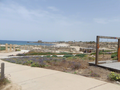
Stadium and port, Caesarea, in 2024.
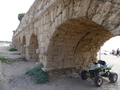
Aqueduct, Caesarea, in 2024.


Explore[edit | edit source]
• 32° 30’ 10’’ N / 34° 53’ 30’’
• +10m
Notes and references[edit | edit source]
Note: Quotations from the work of Maria Valtorta on this page currently use machine-translated text and will gradually be replaced by the official English translation. Until then, the official translation may be consulted through the reference link provided with each quotation.