


Inclusion in the Index of Prohibited Books

On January 6, 1960, the Osservatore Romano, the official Vatican organ, published an article commenting on the decree of Inclusion in the Index of Prohibited Books of Maria Valtorta's Life of Jesus[1].
This Life of Jesus by Maria Valtorta was one of the last works to be placed on the Index before the definitive suppression, in 1966, of this four-century-old catalogue. It was followed only by Jean Steinmann’s Life of Jesus[2] and then by all the works of Pierre Teilhard de Chardin[3]. A prohibited book could neither be published, nor read, nor kept, nor sold, nor translated, nor communicated to others (1917 Codex Iuris Canonici, canon 1398, § 1).
Motivation for the placement on the Index[edit | edit source]
The official decree (see above) states a decision but does not justify it[4]. That was the custom. But there was an obligation to state the causes of the prohibition[5]. The reason for the condemnation was therefore stated at the beginning and at the end of the comment in the Osservatore Romano: a "grave disobedience", in other words a disciplinary but not doctrinal measure, violating the canon 1385, paragraph 1, clause 2 of the 1917 Code of Canon Law. This stipulated that no book dealing with religious subject matter could be published without an imprimatur. The article’s title leaves To Believe as a bad novel but not a harmful work, which is surprising since literary criticism is not normally within the remit of the Church in general or the Holy Office in particular[6]. However, the article’s author mentions "reasons of irreverence" which are interesting to explore as they paradoxically lead to highlighting the high theological value of the work, which he mentions three times[7] and other highly interpretive elements noted in the responses from Emilio Pisani or Hélène Thils (see below).
The context[edit | edit source]
It is important to read carefully this text from the Osservatore Romano which can only be understood in the light of its historical context. This context is only briefly mentioned at the end of the article without a precise date: "These words invoke memories[8] from about ten years ago, while certain voluminous typed texts, which contained alleged visions and revelations, were circulating" and the author adds: "It is known that at that time the competent ecclesiastical authority defended the printing of these typed texts and ordered them withdrawn from circulation."
This event, of which the article’s author has only a distant memory, took place on Tuesday, February 22, 1949. It concerned Father Berti who was neither the author, nor the editor, nor the printer of the work. It was one of the twists in the fierce confrontation that took place between 1948 and 1952 about Maria Valtorta’s work, between the circle of Pope Pius XII (accused of naivety[9]) and the leadership of the Holy Office. After an apparent stalemate, the confrontation resumed after the death of Pope Pius XII with the placing on the Index, but only for a brief time: the procedure was abolished six years later.
Comments in response to the article of the Osservatore Romano[edit | edit source]
Emilio Pisani[edit | edit source]
Historical publisher of Maria Valtorta, Emilio Pisani (1935-2023) took over from his father by creating the Centro Editoriale Valtortiano (1985) with Claudia Vecchiarelli his wife, then the Foundation which became the Maria Valtorta Heritage Foundation (2010). As a young man, he witnessed, through Father Berti, the clashes with the Holy Office and the vicissitudes of the publishing. He met Maria Valtorta. The comments below were published in Italian in Pro e contro Maria Valtorta."The original title was “The Poem of Jesus” but it had been changed already at the publication of the first copies of the first volume because a publishing house claimed the use: they had given it to a book in verse already published. The Work therefore changed its name to “The Poem of the God-Man.” The author of the Work was anonymous because the writer should not and did not want to be known during her lifetime. Maria Valtorta’s name therefore does not appear on the Index.
- The motivations (of the decree)
On the first page of L’Osservatore Romano, an unsigned article, entitled “a badly novelized life of Jesus” gave reasons for the condemnation. The article, which took up a full column in the newspaper, consisted of four parts, which we quote fully below, in italics, interspersed with our comments at the end of each.
- Here is the beginning:
Although their theme is exclusively religious, the stated volumes have no imprimatur, as required by Can. 1385, § 1 no. 2 of the Catechism of the Catholic Church [...][10] For anyone who has the patience to read these nearly 4000 compact pages, the reasons are easy to discern.Let us pause for a first comment. If the Work did not have the imprimatur, as is required for books dealing with religious subjects, it is because the Holy Office, “supreme” authority, had forbidden the competent bishop from granting it. Msgr. Michele Fontevecchia, who was visually impaired, had the typed copies of the Work read to him by Gabriella Lambertini, a Missionary sister of the “Pro Civitate Christiana” association in Assisi; he would willingly have given his imprimatur, as Ordinary of the diocese where the publisher-printer resided, if the Holy Office had not prevented him[11].
In his short preface, the publisher ventured a comparison with Dante so that the reader would feel free to interpret the "visions" as literary fiction. The author of the article in question could certainly consider such a comparison as “vanity,” just as he criticized the literary form of the Work (lengths, prolixity, badly written novel) according to his sensitivity as a reader, but not as an ecclesiastical reviewer censoring possible doctrinal deviations.
The “illustrious personalities” who supported the publication did not deserve the insinuation of having been deceived. They were prestigious names of ecclesiastics and laypeople[12]. Their attestations and testimonies show them aware of the validity of the Work written by Maria Valtorta, whose typed copies they were able to examine. Some of them even helped to disseminate the volumes from the time of publication and showed solidarity with the publisher after the placing on the Index. We thus see how the reasons justifying the placing on the Index were “easy to discern”…
- Now let us look at the second part of the article.
The reader is struck by the length of the speeches attributed to Jesus and the Blessed Virgin, as well as by the interminable speeches of the many characters who populate these pages [...][10] A thought comes to us spontaneously: this Work, by its nature and in accordance with the intentions of the author and editor, could easily fall into the hands of nuns and students of their colleges. In that case, reading such passages might cause spiritual harm.Let us pause for our second comment. Once again, the censor points out the length of the Work and positions himself as a literary critic. When comparing it to the conciseness of the Gospels, he lets slip high praise: “theological courses in the terms used by a professor today” and “lessons in Marian theology, consistent with the most recent studies of specialists currently in this field.”
The Gospels recount certain cases where Jesus did not allow his human-divine nature to be disclosed (the so-called “Messianic Secret”) but without explanation. Maria Valtorta’s Work, which rightly presents Jesus as the Messiah and Son of God, reports circumstances in which Jesus recommends not to say who he is, or not to proclaim what he has done, and gives each time an appropriate reason.
The critique on the manner of representing Jesus’ Mother is unsupported by any citation; it is an obvious prejudice contrasting with the thoughtful and documented judgment of the illustrious mariologist Gabriele M. Roschini, consultant to the Holy Office, whose book, entitled “The Virgin Mary in the Writings of Maria Valtorta”, was reprinted with a reproduction of the letter of appreciation from Pope Paul VI.
As if retracing his steps, the censor-reader again criticizes the text’s form by labeling the narrative slow and talkative, without citing a single passage and without being able to censor it as heretical, blasphemous or simply disrespectful.
As for the new facts and new parables reported in the Work, one can simply refer to the Gospel of John (20:30 and 21:25) and, for the women who follow Jesus, to a passage in Luke (8:2-3).
It is only at this point that we come to a first moral judgment. It includes the first citation of some examples with precise references to the passages in question. This reference allows the reader to check whether their risqué aspect was an end in itself, as “in some descriptions or scenes of modern novels,” or whether their purpose was different and higher. Without discernment, the Bible itself would be placed on the Index. As for the possibility of spiritual harm caused by these pages, the censor targets only a very limited category of persons: nuns and students of their colleges.
- Let us move on to the third part of the article.
Specialists in biblical studies will certainly find many historical, geographical or other errors. But since this is a… novel, these inventions obviously increase the picturesque and fantastic aspect of the book. Amid such ostentatious theological culture [...][10] Finally, I indicate another strange and imprecise statement, in which Mary is told: "As long as you remain on earth, be second behind Peter in the ecclesiastical hierarchy..."Let us pause for the third comment. The presence of historical, geographical or other errors was given as certain, but none were found. Had any been found, they might have warranted the disapproval of the specialists in biblical studies, but not the condemnation of the guardians of faith and morals. Perhaps for this reason, the censor avoided citing them.
Returning to his personal task, he continues his exploration “amid such ostentatious theological culture” — thus nothing to do with a novel — and extracts four “pearls” (one every 1000 densely printed pages!) that would not shine with orthodox light. Let us examine them.
The first is “a rather bizarre and inaccurate opinion,” which does not amount to a decidedly erroneous opinion.
The second is a statement that could have been heretical if its explanation had not limited its meaning (therefore it is not heretical); it would have been inappropriate if it had given rise to a new mariology (therefore it is not inappropriate until proven otherwise). He even adds: luckily.
The third is a concept expressed in a hermetic and confused manner. Were it not so, it would not have escaped the harshest censorship. In short, it is impossible to censor.
The fourth and last “pearl” is even non-existent. It is a “strange and imprecise” statement, because the censor does not quote it fully. If, instead of the ellipsis he had included the rest of the phrase (which is him as head and you as faithful), the concept would have become clear and precise.
So there is no censorship in matters of Christian faith, only attempts to censor.
- Now let us look at the conclusion:
The Work would therefore have deserved condemnation even if it were a simple novel, at least for reasons of disrespect [...][10] Therefore, this public condemnation of the Supreme and Sacred Congregation is all the more opportune as we are dealing with a case of grave disobedience.In conclusion, the Work is no longer a novel and deserved condemnation "for reasons of irreverence" not specified. However, the disciplinary motive for the condemnation is clearly stated; there was grave disobedience to the order of the competent ecclesiastical authority not to publish this work.
We know in fact that, ten years earlier, the Holy Office had ordered religious not to publish without imprimatur the contents of the “voluminous typed manuscripts” they were circulating. Their printed reproduction in the Work in four volumes was considered a “grave disobedience,” without taking into account that it was legitimized by a formal agreement between the writer and a lay publisher.
This article of the Osservatore Romano, published concurrently with the Holy Office’s decree, gave the motives for an abnormal sentence, condemning an innocent: the Work, instead of the guilty, real or presumed."
Hélène Thils[edit | edit source]
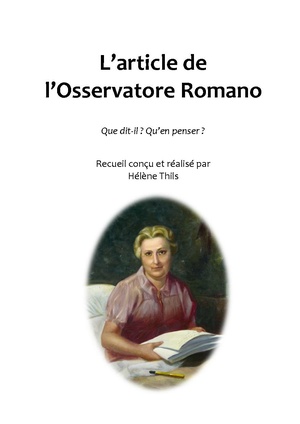
Hélène Thils is a video speaker and administrator of the shared forum. She collaborates, among others, with the Maria Valtorta Heritage Foundation.
SUMMARY OF THE BOOKLET ABOVE
- Introduction.
- Observation No. 1: these volumes do not have the slightest « imprimatur », as required by Canon 1385, 1 n. 2 C.I.C.
- Observation No. 2: in this kind of novelized story, Jesus is excessively talkative.
- Observation No. 3: Jesus looks like a propagandist, always ready to proclaim himself Messiah and Son of God.
- Observation No. 4: Jesus gives lessons in theology in the same terms a theology professor would use today.
- Observation No. 5: Mary is always ready to provide lessons in Marian theology, fully informed of the latest studies by current specialists in this field.
- Observation No. 6: The Most Holy Virgin has the eloquence of a modern lawyer.
- Observation No. 7: The Holy Virgin is present everywhere.
- Observation No. 8: The narrative proceeds at a slow pace of vain chatter; there are new facts, new parables, new characters, and a whole retinue of women following Jesus.
- Observation No. 9: Risqué pages reminiscent of descriptions and scenes from modern novels. The example of Aglae’s confession.
- Observation No. 10: a ballet surely performed immodestly before Pilate in the Praetorium (volume 4, p. 75), etc.
- Observation No. 11: reading passages of this kind... could hardly be done without danger or harm on a spiritual level.
- Observation No. 12: Specialists in biblical studies will certainly find many historical, geographical and other errors. If it’s just a… novel, these inventions obviously increase the picturesque and fantastic aspect of the book.
- Observation No.13: On the subject of the sin of Adam and Eve, there is a rather extravagant and inaccurate opinion.
- Observation No.14: Mary is the second-born of the Father.
- Observation No.15: a statement on Paradise that is hermetic and confused.
- Observation No.16: a strange and imprecise statement. "You, as long as you remain on Earth, will assist Peter «as ecclesiastical hierarchy»."
- Observation No.17: The work shows irreverence.
- Observation No.18: One reads the words “Jesus said…”, “Mary said…: ” (…) and Maria Valtorta claims to have seen the entire messianic time.
- Observation No.19: this condemnation is based on memories… from about ten years ago (…) and is all the more opportune as it concerns grave disobedience.
CONCLUSION 40.In our preamble, we particularly wondered whether the arguments of the Osservatore Romano were credible. After our analysis, we think their statements can be divided into several categories. We thus find:
- Arguments based on facts: this concerns the imprimatur. However, this disciplinary sanction is biased, because we saw that the Holy Office pressured so that the imprimatur was not granted.
- Subjective arguments: when the Osservatore thinks Jesus is a propagandist, that the narrative proceeds at a slow and vain chatter pace, or that specialists in biblical studies will certainly find many errors in this work, it is a personal, arbitrary opinion derived from their reading of the work. Another reader may have a completely different feeling. As soon as these arguments are subjective, they lose their force; they can even be entirely dismantled by scholars’ analysis, such as Jean-François Lavère’s work. A recontextualization can also help understand that their interpretation is false and mistaken.
- Doctrinal arguments, which highlight imprecise, confused, hermetic statements. We tried to highlight these last ones to prove that everything is in accord with Catholic doctrine in the narratives given to Maria Valtorta.
- Generalizations: when the Osservatore Romano says the Holy Virgin is present everywhere or that Mary is always ready to teach theology, without citing passages to support these arguments, we consider that the Holy Office states alleged general truths. However, these mislead the reader, since such things are not found in the GRM. These Holy Office observations therefore distort Maria Valtorta’s writings.
We therefore do not agree with the Osservatore Romano’s statements and have tried to demonstrate as best as possible why we think differently. Again, we respect the point of view of each reader. We have defended this Work because it is a source of Graces for many faithful: it enlightens the canonical Gospel and makes us love the Lord ever more. We therefore believe it must be defended and disseminated so Souls can advance ever more towards God and cling to His Light. We thus invite the reader to form their own opinion on the matter, for one is never better enlightened than by their own Conscience and Heart. Read the work, even if only by starting at the beginning of the public life (It begins in GRM 44), and see if it makes grow in you the twelve Fruits of the Spirit. That is the best sign to see if God is with us, or not. If you like it and it elevates you towards the Lord, continue to discover it. And if you do not connect with this private revelation, the Church still has countless treasures to offer you.
May the Lord keep you and bless you.
Testimonies of Marta Diciotti[edit | edit source]

Marta Diciotti was the caregiver who looked after Maria Valtorta, bedridden for 27 years, day and night. Her memories were compiled by Albo Centoni in his book: "Una vita con Maria Valtorta. Testimonianze di Marta Diciotti" (CEV) 1987.
It was by radio, in Viareggio, in the 5 p.m. news of this Tuesday January 5, 1960, that Marta Diciotti learned the news which stunned her: the placing on the Index of the Poema del Uomo Dio, four volumes, author unknown. She rushed to inform Maria Valtorta in the next room. She shook her: "They put your writings on the Index!" Maria Valtorta, who had been in prostration for four years, simply replied, with great pain in the depths of her gaze: "I knew it," then fell back into her silence. Marta then understood that she already knew everything before her and that her pain was immense.
Here are two testimonies about the placing on the Index: the announcement on the radio, then the symbolic dream she had:
The announcement of the placing on the Index of the Work[edit | edit source]
(Indicative translation)"The announcement on the radio of the placing on the Index of the Poem on January 5, 1960, was a terrible thing for me. In talking about it, I feel like reliving those moments.I was in the kitchen doing I don’t know what, while listening to the radio I had placed in the living room, after having removed it from Maria’s bedroom. For a long time, she no longer listened to anything. Four years had passed since the first signs of her psychological detachment, which had steadily progressed toward an ever deeper and more absolute silence.
She hardly spoke, her voice was rarely heard for a few words. The radio, placed on that small table between her bed and mine, no longer had any reason to stay there: it had always bothered me there, especially when I had to take care of her. I had therefore decided to move it to the dining room, between the French door leading to the courtyard and the small door leading to the kitchen, where the television is today.
The evening shadows fell more and more that day, sadly unforgettable for me, when the 5 p.m. news announced, among other news, the placing on the Index.
It was a terrible surprise for me, a thunderclap in a serene sky: I never would have expected such a thing. And why, why then? I could not understand. ‘’What a disaster, my God! What a disaster! What a disaster!‘’ I kept repeating to myself. ‘’Now that things were finally beginning to stabilize, to get a little better!‘’
In 1959, the end of that first so laborious edition had finally been reached, as modest as one wanted, but finally out of the presses. Moreover, a discreet success seemed to be looming, thanks to the keen interest aroused by the Work and the flattering welcome it seemed to be getting everywhere. ‘’Probably,’’ I had thought, ‘’the darkest years, the most troubled uncertainties, the anxieties, the worries (including economic ones) are about to gradually fade away, and perhaps disappear forever.‘’
And here everything started again, worse than before! Because before, there was at least hope for the future. But now? Now, there remained nothing but to bury, with the Work itself, all hope. It was over, yes, really over!
But who could say it? I, in any case, never expected such a thing: I had not thought about it, or at least, I would never have believed it possible.
And Father Berti? He knew nothing? Had he not thought about it? Had he no fears about it? He surely knew something, he must have had some fears. And now? Now, what could I, what should I do? The terrible words of the radio announcement echoed in me: ‘’The Poem of the God-Man, author unknown, in four volumes, published by the Pisani publishing house of Isola del Liri, has been placed on the Index.’’ So? So, was it all a deception? A miserably collapsed mystification before reality?
That evening, I understood nothing anymore. Like a fury, I rushed into Maria’s bedroom, where she was, half propped up on her pillows, as always. I grabbed her by an arm and shook her, as one shakes a tree to make the fruits fall, and told her: ‘’You see? They put your writings on the Index!‘’
She turned to me, looked at me… and looked at me in such a way… that I don’t know how to describe what I felt. It was as if my eyes had opened onto a world of another dimension. As if I had received a blow on the head and everything had collapsed at my feet. But I did not know, I do not know and I will never be able to explain the feeling I experienced. Her look was so deep, so meaningful, so tragically painful… that perhaps… here it is: it gave me the impression that she already knew everything before me, and that her pain was immense. Indeed, she replied to me very clearly: ‘’I knew it.‘’ Then she fell back into silence, like a closed and sealed tomb.
I felt annihilated by an immense pity that overwhelmed me, and I stopped, horrified by the violence I had let myself be carried away by a few moments earlier. I didn’t know what else to say.
I too, like her, embraced my cross and silently submitted to everything that happened in those days. And those were terrible days, better not to remember.
Like a painful wound, the sensation of a great wrong done to us, of a brutal and stupid violence imposed on us… the conscience of a sad and even pitiable error remained with me for a long time, like that of a heavy and Unjust judgment, about which one could only inevitably repent.
In my mind there passed facts and names of famous people who had long suffered under the weight of stupid and cruel condemnations, and who, even if they had escaped execution, remained marked for the rest of their mortal lives, crushed under the same weight.
But I was no longer the rebellious and somewhat contesting young woman who had entered this house twenty-five years earlier. I hadn’t lived all those years with a woman like Maria Valtorta for nothing. That is why I asked the Lord’s forgiveness for all my errors and submitted to His holy will. I clung to Him and to His holy Church.
I never doubted the supernatural origin of the Writings. And besides, how could Maria have written the pages of the Poem without the necessary culture and indispensable consultations? If what she writes there is truly historical, that is, entirely in conformity with historical reality, it is up to the Church to say so through its experts. Who could judge otherwise?
Maybe it is wrong to reason like this, but it does not seem so to me.
I never doubted the sincerity of this woman either, who, according to me, never lied, simply because she could not.
People will say it’s the reasoning of a little woman, which I really am, but I don’t know how to think otherwise about her. All the very long life experience lived together and in such close contact confirms it to me with the force of logic, even if my discourse is not logical.
Then, one might ask me: what took me that evening of January 5, 1960, to go there shaking that poor woman?
Certainly, my gesture was anything but good: it was even less intelligent and coherent. But, thinking back, I could say that it was the inconsiderate attitude of a poor little woman, precisely, surprised, scared and above all tired, so tired of suffering.
However, to restore my shaken balance and faltering wisdom, that look I will never forget and those two simple and luminous words emerging from her isolation were enough.
I believe it was the first and last time that I had Doubts on this subject[13]."
The dream I had after the placing on the Index[edit | edit source]
(Indicative translation)
"A few days after January 5, 1960, the date on which the Holy Office decree (of December 16, 1959) placing the Poem on the Index was published — it is worth specifying here that only the four volumes of the first edition, published under an anonymous author, were placed on the Index — I received a letter from a person giving me the "good news” ... in case I had not yet learned it by chance! And she certainly did not announce it to me kindly. In this letter, among other things, I was told that there was nothing more to be done. At that time, it really seemed that everything was over.One can easily imagine what my state of mind was in those days: alone, afflicted, with no hope for the future, with that poor creature Maria had become in the last times of her earthly life, and with the task of Saving the Writings, which the Church had just condemned.
Then, one of those nights, I had a dream. It seemed I had to answer that letter, and I found myself in Maria’s room. I had opened the wardrobe and was looking among the handwritten notebooks for a dictation where it said something contradicting the inevitability of the event. I wanted, in short, to reply with testimonies affirming the opposite about the future of the Writings.
— Outside of this dream, there are indeed many affirmations on this subject, including by the Blessed Virgin, who says for example: ‘’The Work is in my hands.’’ And so on.
I was looking therefore, looking for something precise, and I wanted to find it to reply accurately to the letter. I moved, yes, but seeing that I could not orient myself in this sea of notebooks where Maria, on the other hand, knew how to navigate with such assurance, I felt overtaken by a feeling of Discouragement. Dejected, I said to myself: ‘’Bah! It’s useless. After all, the Poem has been placed on the Index!’’ This feeling of discouragement, of dejection, became more and more intense, and I felt drawn into the bitterness of total surrender. No, there really was nothing left to do!
Suddenly, while I had all these books in my arms — and here they began to multiply, to multiply, to grow enormously — I noticed a strange thing: the more they grew, the lighter they became, the more they lightened, until they became like feathers… And they grew!… grew!… to the point of almost covering me entirely.
Suddenly, while I was putting these volumes on a chair next to me, I was attracted by a gaze and turned around. I looked up and, at the back, near the stairs, I saw a person, like a priest, a very neat young priest, perhaps even too much.
Surprised, I said to him: ‘’And you, who are you? How did you get in without asking permission?’’ ‘’The door was open,’’ he replied. ‘’Well then! — I said — you could have asked for permission!’’
He burst out laughing and, while pointing to the books with a gesture of hand and thumb, with a wink, began to say while laughing: ‘’We succeeded, huh! We succeeded, huh! We succeeded, huh!’’ He repeated it three times, and sneered again.
Then, instinctively, I began to make the sign of the cross slowly, well done, without haste: at the first sign of the cross, his face, of a light and normal color, began to become reddish, then red, then a burning red, a brick red… increasingly intense as I made the sign of the cross.
At a certain moment, this intruder didn’t know where to look anymore and was lost. He turned his eyes to the right, towards the stairs, but looking up, he met the intense gaze of that Jesus of the portrait that is — and has always been — on the landing, halfway up the stairs. At this sight he made a violent gesture, raising his arms, a hand lowered and covering his head, as if to protect himself from something falling heavily on him. He gave a furious look to the opposite side, towards the entrance door where he had entered, leapt like a feline toward it and fled, disappearing into Via Antonio Fratti.
And I woke up, frightened by that murderous and terrified gaze of those eyes that were looking for a way out[13]."
Aftermath[edit | edit source]
In December 1960, Father Berti was called back to the Holy Office where he was better received by a new commissioner who declared to him, after several back-and-forths and consultation of his hierarchy: "Continue publishing this second edition. We will see how the world receives it."
On July 1, 1961 an incendiary article appeared on Maria Valtorta’s work, then at its second edition. This commentary, "no doubt commissioned by a Vatican authority"[14], reports that the author is "currently affected by a serious form of mental alteration" and that the second edition, despite being very similar to the first, is "a monument of childishness, fantasies and historical and exegetical falsehoods, diluted in a subtly sensual atmosphere."
On October 12, 1961, Maria Valtorta died.
On December 1, 1961, the Osservatore Romano published a brief note extending the prohibition to the second edition, the minimalistic form of which raises questions.
June 14, 1966, the Index procedure is abolished.
Notes and references[edit | edit source]
- ↑ Decree dated December 16, 1959,
- ↑ Jean Steinmann (1911-1963) was an Oratorian, specialist in biblical studies and author of 18 works including one posthumously. Vicar at Notre-Dame de Paris, he was never particularly troubled for his opinions by Cardinal Feltin, Archbishop of Paris at that time. "The Life of Jesus" (Paris, Éd. Denoël, 1961, 251 p.) was placed on the Index on June 26, 1961, on the grounds that it "confined his character within human limits [...] The figure of Jesus, as it emerges from Mr. Steinmann's work, is that of a Jesus seen through the filter of imagination and daring exegeses" (cf. "Placement on the Index of "The Life of Jesus" by Father Steinmann", Le Monde, June 29, 1961). This is the same view on the "Life of Jesus badly novelized" which summarized the opinion of the censors of the Holy Office on Maria Valtorta's work eighteen months earlier. After the accidental death of Jean Steinmann in Jordan, his lectures were published under the title A Christian Faith for Today, (Paris, Éd. Grasset, 1967, 251 p.) prefaced by Yves Congar.
- ↑ Decision of June 30, 1962. Pierre Teilhard de Chardin (1881-1955) was a Jesuit scientist advocating innovative ideas about evolution and original sin. His condemnations were posthumous. Benedict XVI and Pope Francis have, however, cited his works that seem to be rediscovered.
- ↑ Translation of the decree: "Supreme and Sacred Congregation of the Holy Office - DECREE - Prohibition of books - Friday, December 16, 1959. In general assembly of the Supreme and Sacred Congregation of the Holy Office, their Eminences the most Reverend Cardinals charged with vigilance in matters of faith and the Protection of morals, with the prior assent of the Consultors, condemned an anonymous work, consisting of four volumes, the first entitled "Il Poema di Gesù" (Publisher M. Pisani, Isola del Liri) and the rest "Il Poema dell’Uomo-Dio" (ibid) and ordered its insertion in the list of prohibited books. And on Friday the 18th of the same month and year, His Holiness D. N. D. IOANNES, by divine Providence Pope XXIII, approved, in the audience granted to his Eminence the reverend Cardinal Secretary of the Holy Office, the decree that was proposed to him by their Eminences and ordered its publication. Given in Rome, at the bureau of the Holy Office, January 5, 1960. Sebastian Masala, notary (apostolic)."
- ↑ 1917 Code of Canon Law, canon 1397, paragraph 2.
- ↑ The placing on the Index of "The Three Musketeers" or "Les Misérables" or "Notre-Dame de Paris" had more to do with the morals described (Salton the Holy Office) than with their literary quality. Decree of June 22, 1863, for the novels of Alexandre Dumas father and son. Decree of June 20, 1864, for Victor Hugo.
- ↑ "Expositions of theology in terms a professor would use nowadays" .... "Marian theology updated according to the most recent studies by current specialists in this area" ... "great display of theological knowledge".
- ↑ This very vague reference is unusual in a document dealing with a condemnation. Instead of giving a precise date or a reference, the article uses a periphrasis appealing to "memories": "Queste parole fanno ricordare che, circa dieci anni fa (These words call back about ten years ago)...". One explanation may be the change in the file on Maria Valtorta’s case made by the Holy Office after the death of Pius XII. Originally constituted in 1945 under No. 355/45, it became 144/58 in 1958. The file no longer apparently contains references to the Sovereign Pontiff's refusal to follow up the Holy Office’s proposal for condemnation of February 17, 1949. Otherwise, the article’s author would have cited it. The new file (which will support the placing on the Index and Cardinal Josef Ratzinger's first opinion) apparently retains the critical reports of Alberto Vaccari or the last one of Cardinal Bea.
- ↑ "...despite the illustrious personalities (whose unquestionable good faith was surprising) who supported the publication ..."
- ↑ 10.0 10.1 10.2 10.3 We abbreviate citations from the Osservatore Romano article which are fully presented elsewhere.
- ↑ He was not the only one to have been "prevented". Before him there was Msgr. Constantino Barneschi who granted the imprimatur. He was contested. Then Msgr. Biagio Musto from whom the imprimatur was “snatched”. Finally Cardinal Giuseppe Siri, although favorable, declined the imprimatur offer as it was deemed "perilous".
- ↑ They signed the Petition to the Pope, January 29, 1952 which, out of respect for procedures, ended up at the Holy Office where it remained. It was initiated by Msgr. Alfonso Carinci and included statements from Cardinal Augustin Bea and Msgr. Ugo Emilio Lattanzi, among others.
- ↑ 13.0 13.1 ALBO CENTONI - Una vita con Maria Valtorta, Marta Diciotti, {it} pp. 96-97.
- ↑ François-Michel Debroise, À la rencontre de Maria Valtorta, tome 1, sa vie, CEV, 2019, p. 109.