


Osservatore Romano (01/06/1960)
 See also:
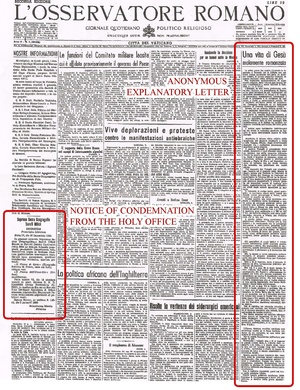
On January 6, 1960, the Osservatore Romano, the official Vatican newspaper, published an article commenting on the decree dated December 16, 1959, about the Inclusion in the Index of Prohibited Books of the life of Jesus by Maria Valtorta. The article is unsigned, as is customary, but it appears to have been largely inspired by the reports of Father Alberto Vaccari and Cardinal Augustin Bea, whose arguments it reprises, although with some moderation.
Italian text[edit | edit source]
Da L’Osservatore Romano di mercoledì 6 gennaio 1960UNA VITA DI GESÙ MALAMENTE ROMANZATA In altra parte del nostro Giornale è riportato il Decreto del S. Offizio con cui viene messa all’Indice un’Opera in quattro volumi, di autore anonimo (almeno in questa stampa) edita all’Isola del Liri.Pur trattando esclusivamente di argomenti religiosi, detti volumi non hanno alcun «imprimatur», come richiede il Can. 1385, § 1 n.2 C.I.C.
L’Editore, in una breve prefazione, scrive che l’Autore, «a somiglianza di Dante, ci ha dato un’opera in cui, incorniciati da splendide descrizioni di tempi e di luoghi, si presentano innumerevoli personaggi i quali si rivolgono e ci rivolgono la loro dolce, o forte, o ammonitrice parola. Ne è risultata un’Opera umile ed imponente: l’omaggio letterario di un dolorante infermo al Grande Consolatore Gesú».
Invece, ad un attentato lettore questi volumi appaiono nient’altro che una lunga, prolissa vita romanzata di Gesù.
A parte la vanitá dell’accostamento a Dante e nonostante che illustri personalitá (la cui indubbia buona fede è stata sorpresa) abbiano dato il loro appoggio alla pubblicazione, il S. Offizio ha creduto necessario metterla nell’Indice dei Libri proibiti.
I motivi sono facilmente individuabili da chi abbia la certosina pazienza di leggere le quasi quattromila pagine di fitta stampa.
Anzitutto il lettore viene colpito dalla lunghezza dei discorsi attribuiti a Gesù e alla Vergine SS.ma; dagli interminabili dialoghi tra i molteplici personaggi che popolano quelle pagine.
I quattro Vangeli ci presentano Gesú umile, riservato; i suoi discorsi sono scarni, incisivi, ma della massima efficacia. Invece in questa specie di storia romanzata, Gesù è loquace al massimo, quasi reclamistico, sempre pronto a proclamarsi Messia e Figlio di Dio e ad impartire lezioni di teologia con gli stessi termini che userebbe un professore dei nostri giorni.
Nel racconto dei Vangeli noi ammiriamo l’umiltà ed il silenzio della Madre di Gesú; invece per l’autore (o l’autrice) di quest’opera la Vergine SS.ma ha la facondia di una moderna propagandista, è sempre presente dappertutto, è sempre pronta ad impartire lezioni di teologia mariana, aggiornatissima fino agli ultimissimi studi degli attuali specialisti in materia.
Il racconto si svolge lento, quasi pettegolo; vi troviamo nuovi fatti, nuove parabole, nuovi personaggi e tante, tante, donne al seguito di Gesù.
Alcune pagine, poi, sono piuttosto scabrose e ricordano certe descrizioni e certe scene di romanzi moderni, come, per portare solo qualche esempio, la confessione fatta a Maria da una certa Aglae, donna di cattivi costumi (vol. I, p.790 ss.), il racconto poco edificante a p. 887 ss. del I vol., un balletto eseguito, non certo pudicamente, davanti a Pilato, nel Pretorio (vol. IV, p. 75), etc.
A questo punto viene spontanea una particolare riflessione: l’Opera per la sua natura e in conformità con le intenzioni dell’autore e dell’Editore, potrebbe facilmente pervenire nelle mani delle religiose e delle alunne dei loro collegi. In questo caso, la lettura di brani del genere, come quelli citati, difficilmente potrebbe essere compiuta senza pericolo o danno spirituale.
Gli specialisti di studi biblici vi troveranno certamente molti svarioni storici, geografici e simili. Ma trattandosi di un… romanzo, queste invenzioni evidentemente aumentano il pittoresco e il fantastico del libro.
Ma, in mezzo a tanta ostentata cultura teologica, si possono prendere alcune… perle che non brillano certo per l’ortodossia cattolica.
Qua e là si esprime, circa il peccato di Adamo ed Eva, un’opinione piuttosto peregrina ed inesatta.
Nel vol. I a pag. 63 si legge questo titolo: « Maria puó essere chiamata la secondogenita del Padre » : affermazione ripetuta nel testo alla pagina seguente. La spiegazione ne limita il significato, evitando un’autentica eresia; ma non toglie la fondata impressione che si voglia costruire una nuova mariologia, che passa facilmente i limiti della convenienza.
Nel II vol. a pag. 772 si legge: « Il Paradiso è Luce, profumo e armonia. Ma se in esso non si beasse il Padre, nel contemplare la Tutta Bella che fa della Terra un paradiso, ma se il Paradiso dovesse in futuro non avere il Giglio vivo nel cui seno sono i Tre pistilli di fuoco della divina Trinità, luce, profumo, armonia, letizia del Paradiso sarebbero menomati della metà ».
Qui si esprime un concetto ermetico e quanto mai confuso, per fortuna; perché se si dovesse prendere alla lettera, non si salverebbe da severa censura.
Per finire, accenno ad un’altra affermazione strana ed imprecisa, in cui si dice della Madonna: « Tu, nel tempo che resterai sulla Terra, seconda a Pietro come gerarchia ecclesiastica… » (il corsivo è nostro. N.d.R.).
L’Opera, dunque, avrebbe meritato una condanna anche se si fosse trattato soltanto di un romanzo, se non altro per motivi di irriverenza.
Ma in realtà l’intenzione dell'autore pretende di piú.
Scorrendo i volumi, qua e là si leggono le parole « Gesù dice… », « Maria dice… »; oppure: « Io vedo… » e simili. Anzi, verso la fine del IV volume (pag. 839) l’autore si rivela... un’autrice e scrive di essere testimone di tutto il tempo messianico e di chiamarsi Maria.
Queste parole fanno ricordare che, circa dieci anni fa[1], giravano alcuni voluminosi dattiloscritti, che contenevano pretese visioni e rivelazioni. Consta che allora la competente Autorità Ecclesiastica aveva proibito la stampa di questi dattiloscritti ed aveva ordinato che fossero ritirati dalla circolazione.
Ora li vediamo riprodotti quasi del tutto nella presente Opera.
Perciò questa pubblica condanna della Suprema S. Congregazione è tanto piú opportuna, a motivo della grave disobbedienza.
English translation[edit | edit source]
(Unofficial translation)
Osservatore Romano, Wednesday, January 6, 1960A LIFE OF Jesus POORLY ROMANTICIZED "In another part of our newspaper, the Decree of the Holy Office placing on the Index a work in four volumes, by an anonymous author (at least in this edition) published at Isola del Liri, is reproduced. Although dealing exclusively with religious subjects, these volumes lack the slightest 'imprimatur' as required by Canon 1385, 1 no. 2 C.I.C.[2] The publishers in a short preface write that the author, 'in the likeness of Dante has given us a work in which, amid splendid descriptions of times and places, countless characters address us their words, whether sweet, strong, or admonishing. It results in a humble and imposing work: the literary homage of a suffering sick person to the Great Consoler Jesus.' In reality, a careful reader sees nothing other than a long and verbose romanticized life of Jesus in these volumes. Apart from the presumptuous comparison with Dante and despite illustrious personalities (whose undisputed good faith was surprised) having supported the publication, the Holy Office deemed it necessary to place it on the Index of Prohibited Books. The reasons are clear for anyone with the patience of a Carthusian to read these almost four thousand pages.
First of all, the reader is struck by the length of the speeches attributed to Jesus and to the Most Holy Virgin; and the endless dialogues among the many characters who populate these pages. The four Gospels present Jesus as humble and reserved; his speeches are brief and incisive[3], but always highly effective. Instead, in this kind of romanticized history, Jesus is extremely loquacious, like an advertiser, always ready to proclaim himself Messiah and Son of God[4] and to give theological lectures in the very terms a professor of our time would use[5]. In the Gospel account, we admire the humility and silence of Jesus’ Mother; instead for the author (or authoress) of this work the Most Holy Virgin has the eloquence of a modern propagandist, is present everywhere, always ready to give lessons in Marian theology updated to the very latest studies of current specialists in the field[6].
The narrative unfolds at a slow, almost gossipy pace; we find new facts, new parables, new characters, and an entire retinue of women following Jesus. Some pages are rather risqué and, by certain descriptions and scenes, recall modern novels, such as, to mention only a few examples, the confession made to Mary by a certain Aglae, a woman of loose morals (vol. I, p. 790 ff.[7]), the unedifying account on pp. 887 ff. of vol. I, a dance performed, certainly not modestly, before Pilate, in the Praetorium (vol. IV, p. 75[8]), etc.
This naturally raises the particular observation: the work, by its nature and in accordance with the author’s and editors' intentions, could easily fall into the hands of nuns and female students in their colleges. In this case, reading passages of this kind... could hardly be undertaken without spiritual danger or harm. Biblical scholars will surely find many historical, geographical, and other errors[9]. If it is only a... novel, these inventions obviously increase the picturesque and fantastic character of the book. Amid such a great display of theological knowledge, one can pick some … pearls that certainly do not shine by Catholic orthodoxy. Here and there, concerning the sin of Adam and Eve, a rather extravagant and inaccurate opinion is expressed[10]. In volume 1, page 63, under the title: "Mary may be called the 'second-born' of the Father," a statement repeated at the head of the next page. The clarifications, while avoiding genuine heresy, do not remove the founded impression that a new Mariology is being constructed that easily passes the limits of theological propriety[11]. In volume II, p. 772, it reads: "Paradise is light, perfume, harmony. But if in it the Father did not delight in contemplating the Most Beautiful Lady Who changes the Earth into a paradise, if Paradise in future should not have the living Lily in Whose bosom are the three pistils of fire of the Divine Trinity, the light, perfume and harmony, which are the delight of Paradise, would be halved"[12].
This presents a hermetic and more confused than ever notion, which is fortunate, because if it were taken literally, it would not escape severe censure. Finally, note another strange and imprecise statement, in which it says of the Madonna: "During the time that You will remain on the Earth, and You are second to Peter with regards to ecclesiastical hierarchy." (Italics ours. Ed.)[13].
The work would thus have deserved condemnation even if it were only a novel, if only for reasons of irreverence. But in reality, the author's intention goes even further. Reading through the volumes, here and there one reads the words "Jesus says…," "Mary says…"; or even: "I see..." and others similar. And towards the end of volume IV (p. 839) the author reveals herself a woman who declares to have witnessed all the messianic time and to be called Mary (Valtorta).
These words evoke memories of about ten years ago[1], when some voluminous typescripts were circulating, containing alleged visions and revelations. It is known that the competent ecclesiastical authority then had forbidden the printing of these typescripts and had ordered them withdrawn from circulation[14]. And now we see them reproduced almost in full in the present work.
This public condemnation of the work by the Supreme Sacred Congregation is therefore all the more appropriate because it involves grave disobedience.
Notes and references[edit | edit source]
- ↑ 1.0 1.1 This very vague reference is unusual in a document dealing with a condemnation. Instead of giving a precise date or even a reference, the article uses a circumlocution that "calls upon memories": "These words recall that, about ten years ago..." One explanation may be the change of file on the Maria Valtorta case the Holy Office made after the death of Pius XII. Originally created in 1945 under no. 355/45, it became 144/58 in 1958. The file no longer apparently contains references to the Sovereign Pontiff's refusal to follow up on the Holy Office’s condemnation proposal of February 17, 1949. Otherwise, the article’s author would have cited it. The new file (which will support the Indexation and Cardinal Josef Ratzinger’s first opinion) apparently still keeps the critical reports of Alberto Vaccari and the last one of Cardinal Bea.
- ↑ Article 1385, paragraph 1, § 2 of the 1917 Code of Canon Law, in force at the time of Maria Valtorta, stipulated that no book on a religious subject could be published without an imprimatur.
- ↑ The Gospel of John contradicts this statement: it reports a 118-verse discourse of Jesus on the night of the Last Supper, spanning from John 13:38 to John 17:26. Not to mention the Sermon on the Mount of Matthew, reported over several chapters. This does not diminish the striking formulas Jesus uses both in the Gospel and in Maria Valtorta's work.
- ↑ See John 5:18: "This is why the Jews tried all the more to kill him, because he not only broke the Sabbath but said that God was his own Father, making himself equal to God."
- ↑ This is consistent with The Gospel as Revealed to Me: Jesus is the source and the summit of Christian theology. "Theology originates from the Word of God and aims to make this Word known in order that it be loved." (Cf. Summa Theologica, I, q.1, a.1).
- ↑ Father G. M. Roschini, himself a member of the Holy Office and founder of the Pontifical Marian University (Marianum), comments on this statement which concerned him personally. He was indeed engaged in defending the work: "The Osservatore Romano of January 6, 1960, which published a severe censure of The Gospel as Revealed to Me, honestly acknowledged in a brief article accompanying the censure notice found in this work "lessons in Marian theology marked by 'a full knowledge of the very latest studies by current specialists' [...], 'lessons in theology' written in the very terms that a professor of our times would use." The article also insinuated that the writer had as a prompter a learned Marian theologian. That was to admit that the work contains a Marian Doctrine quite at the forefront: an undeniable thing! But it is also undeniable that Maria Valtorta never read a book dealing with Mariology, never attended courses or lessons on such a subject, and there was never a learned Marian theologian to suggest to her what she wrote about the Blessed Virgin. Maria Valtorta’s Mariology is not her own invention, that is evident." (Gabriele M. Roschini O.S.M. - The Virgin Mary in Maria Valtorta’s Work - CEV 2021, p. 27).
- ↑ See GRM 168.
- ↑ See GRM 604.26.
- ↑ This point was examined by Cardinal Augustin Bea, director of the Pontifical Biblical Institute. His statement was deposited on the desk of the Holy Office in 1952.
- ↑ Regarding original sin, a fundamental notion, the assertion is particularly vague and imprecise. Maria Valtorta's statements on this subject are summarized in the dedicated article or in what seems to be the main incriminated passage: Original sin: the Serpent seduces Eve then Adam.
- ↑ Pius XII himself, in his radiobroadcast message of May 13, 1946 {pt} on the occasion of Our Lady of Fatima’s feast, did not hesitate to call Mary "firstborn daughter of the Father (Filha primogénita do Padre)." Maria Valtorta’s assertion predates this: August 16, 1944. Saint Maximilian Kolbe was more precise: "Spiritual beings are created in the image and likeness of God, thus of her (the Virgin Mary) it can be said that she is 'Daughter of God'" (Conference of April 9, 1938, cited in Unpublished Spiritual Conversations, the Immaculate Reveals the Holy Spirit, Letheilleux, 2004, p. 51.)
- ↑ See GRM 377.4. Jesus speaks of His Mother.
- ↑ See GRM 455.5.
- ↑ This event, of which the article’s author has only a distant memory, occurred on Tuesday, February 22, 1949 and concerned Father Berti, who was neither the author, publisher, nor printer of the work.