


Zacchaeus

Jewish tax collector (publican) from Jericho. He also did a bit of buying and selling of precious objects "For the racketeer, moneylender, and thief, like all his kind, always has necklaces snatched by threats and usury from some poor person whom he illegally taxes to have watercoup to spend on orgies and women. And he is very friendly with Diomedes who buys and sells gold and flesh..."[1] said Judas who is negotiating with Zacchaeus the jewelry given by Aglae as a sign of repentance.[2] Zacchaeus is converted by Jesus whose sermon on the mountain had touched him.[3] He strips himself of his ill-gotten wealth.
He keeps only one servant:"He is the servant of my father who stayed with me; the others, I dismissed. But he is dear to me. He was the voice that never silenced when I sinned, and I mistreated him because of that. Now, after You, he is the one I love more than anyone else..."
Zacchaeus strips himself of all display: "after opening the gate, he lets Jesus and the Apostles in, and he leads him to the house through the garden which has become a vegetable patch... The house too is stripped of all superfluous things."[4]Following his conversion, he wants to follow Jesus, but during a prayer at the Temple, he feels called to another apostolate: that of the marginalized. He starts to preach to the sinners, the uncircumcised, "publicans, unfortunate like me, keepers of gambling dens, ruffians, moneylenders, overseers of galley slaves and convicts, of slaves, torturers of all miseries, soldiers without law or mercy, revelers..." offering them hospitality until they find a new trade or a new life. Together, they set out to rehabilitate a property on the road to the Jordan. He is helped in all these works by Nike. The group of the reprobates grows to about fifteen people.[5]
Character and appearance[edit | edit source]
40 years old. Small, not very agile or strong. A converted sinner, someone who had a Heart hard heart, who loved his comforts, who was proud, vain, lustful and greedy.
Jesus alludes to him thus:"... old sinner now reborn to Grace, made again by it a young and new being like a young child, having for himself the humility that comes from the memory of having been a sinner, and the determined will to do in the rest of his life as much Good as would suffice to fill a long life wholly devoted to Good, so much so as to make amends, and in a full and overflowing measure, for all the evil he might have done."[6]
His journey[edit | edit source]
The prototype of the "Poor in spirit."[7] On the day of his conversion, he says to Jesus:"Master... I was told about You, some time ago. One day, on a mountain (the Sermon on the Mount GRM 169 at GRM 176), you said so many truths that our doctors can no longer say. They stayed in my Heart... and since then, I think of You... Then I was told that you are good and that you do not reject sinners. I am a sinner, Master. I was told that you heal the sick. I have a sick Heart because I have defrauded, because I practiced usury, because I have been wicked, thief, hard on the poor. But now, here I am, healed because you spoke to me. You came near me, and the demon of sensuality and wealth fled. And I, from today, am yours, if you do not refuse me, and to show you that I am born anew in You, here I strip myself of the ill-gotten wealth. I give you half my goods for the poor and the other half will be used to repay fourfold what I fraudulently took. I know whom I defrauded."[8]
His name[edit | edit source]
Greek form of Zachariah: "God has remembered" - Historical reference: the contemporary prophet Haggai who, like him, urged the rebuilding of the Temple.
Where is he mentioned in the work?[edit | edit source]
GRM 82
GRM 112
GRM 417 GRM 418
GRM 522 GRM 523 GRM 524 GRM 567 GRM 578 GRM 579 GRM 581 GRM 590
Learn more about this character[edit | edit source]
Excerpts from the Dictionary of Gospel Characters, According to Maria Valtorta (Msgr. René Laurentin, François-Michel Debroise, Jean-François Lavère, Salvator Editions, 2012):Legend or tradition gives Zacchaeus married to Veronica (Nike) and exiled in Gaul in Quercy, at Roc Amadour. He would then be around fifty. This estimate is consistent since in 29, at his encounter with Jesus, he was about 40 years old. He would thus be around 55 at the time of the persecutions of Herod Agrippa I which scattered many believers in 44.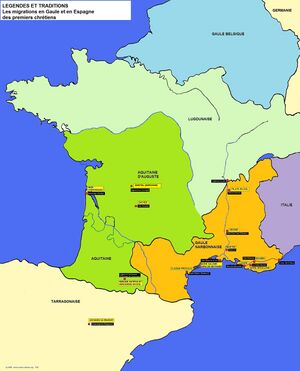 Migrations in Gaul of the first Christians. Source: maria-valtorta.org.
His new name Amadour would derive from amator, the one who loves. This fits well with the story of Zacchaeus, described by Maria Valtorta. That he would be known by a nickname after his "rebirth" should not surprise: similarly, Sidonius is known by the nickname of Restitut (the one to whom Jesus restored the eyes).
His migration to Gaul is plausible: there was indeed a whole emigration during the early persecutions Against the Christians (the family from Bethany for example). Finally giving him married to Nike (Veronica) has some logic: not only is Nike his neighbor, but she also unites with his apostolate in comforting those tested by life. It is very likely a symbolic and not carnal marriage.
This legend of Roc Amadour thus has a plausible basis, if not certain.

Notes and references[edit | edit source]
Note: Quotations from the work of Maria Valtorta on this page currently use machine-translated text and will gradually be replaced by the official English translation. Until then, the official translation may be consulted through the reference link provided with each quotation.